Expertise Brief
Expertise Brief
De novo identification of oxidized phospholipids
Pyxis identifies oxidized phospholipids de novo across two unrelated sample sets, recovering species that reference libraries almost never contain.
Pyxis™ is the Matterworks co-scientist for interpreting omic data and predicting phenotypic biology. Pyxis’ expertise spans several domains, drawing on a set of expert models at our disposal. One of those domains is biochemical omics, the study of small molecules, lipids, and peptides by mass spectrometry, and this brief shows one aspect of that work: the de novo identification of oxidized phospholipids. Pyxis brings PhD-level analytical chemistry expertise to it and works the way careful scientists do: by making an annotation hypothesis and then testing against independent evidence before accepting it.
Why oxidized phospholipids are hard to identify
Oxidized phospholipids are bioactive lipids that accompany inflammation and oxidative stress, and they are a textbook case of biochemical dark matter. They carry real biological signal, and conventional annotation almost never surfaces them, because that annotation depends on a reference library that barely contains them. In the Pyxis reference library, oxidized species account for roughly 0.25% of all phospholipid entries (172 of about 68,600).
Two properties compound the problem. Oxidation multiplies the structural space, since a single phospholipid can carry one added oxygen or many, at more than one position along its acyl chains, so one parent species fans out into a family of oxidized forms. Most of those forms are absent from spectral libraries. A workflow that ranks spectra against a fixed library can only return what it already holds, so nearly every oxidized phospholipid a sample carries stays unannotated, uncounted, and invisible.
Reading oxidation from the spectrum
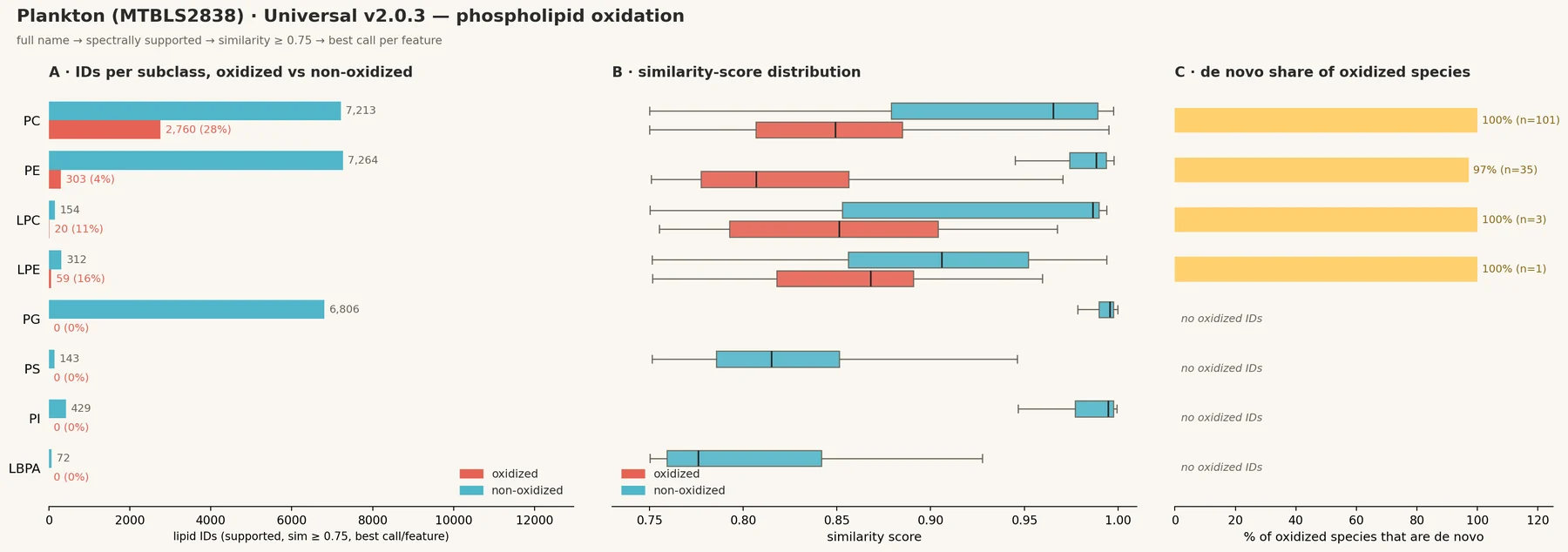
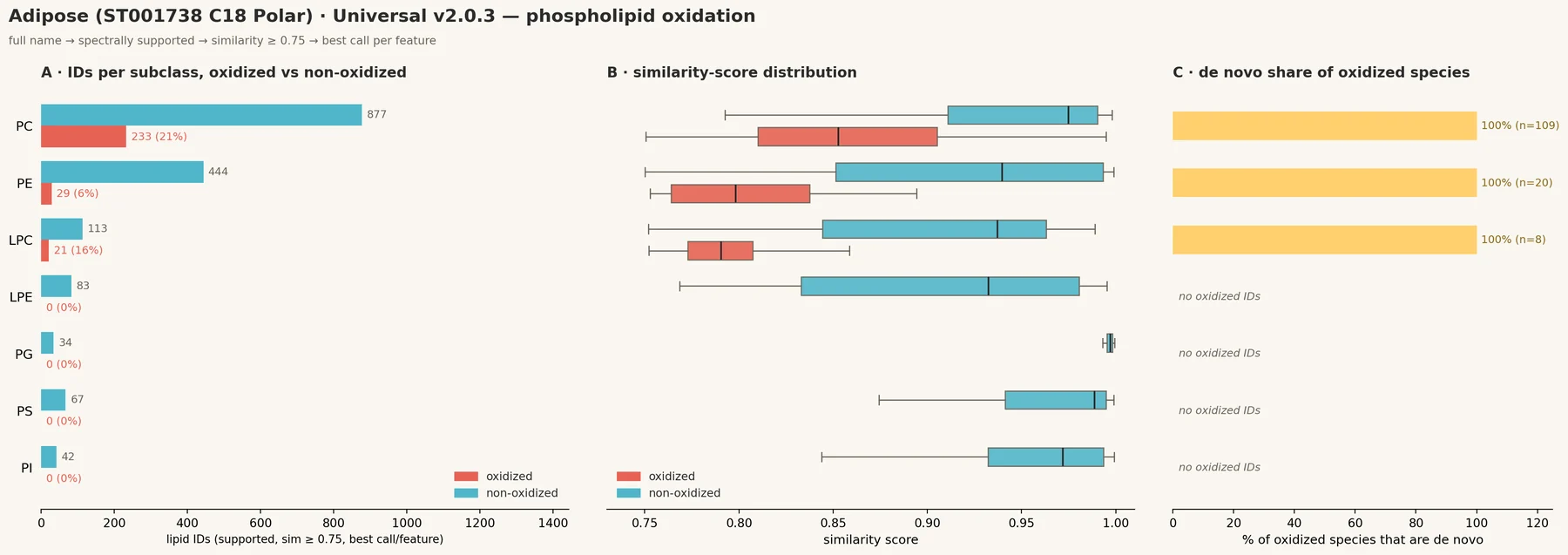
Pyxis works differently. Pyxis reads fragmentation spectra directly and proposes structures de novo, reaching species that fall outside any library.3 To see how far that reaches into oxidized phospholipids, Pyxis’ identifications were examined across two unrelated sample sets, human adipose tissue and marine plankton. Pyxis was given no training specific to oxidized lipids. In each one Pyxis returned a populated set of oxidized phospholipid identifications, hundreds in human adipose and thousands in plankton, and nearly all of them were generated de novo rather than retrieved from a library.
3,142
oxidized phospholipid IDs in marine plankton (PC, PE, LPE, LPC)
~100%
of oxidized species identified de novo, outside the reference library
~0.25%
share of the reference library that oxidized phospholipids represent
Marine plankton · MTBLS28381
A Identifications per subclass, oxidized versus non-oxidized. B Similarity-score distribution. C Share of oxidized species identified de novo. Oxidation concentrates in PC, PE, LPC, and LPE, with 2,760 oxidized PC identifications alone, and is absent from the acidic phospholipids PG, PI, and PS.
Human adipose · ST001738 AdipoAtlas2
A Identifications per subclass, oxidized versus non-oxidized. B Similarity-score distribution. C Share of oxidized species identified de novo. The same pattern holds: oxidation is confined to PC, PE, and LPC, and the acidic phospholipids remain unoxidized.
Testing every call against independent evidence
Pyxis does not stop at the annotation. Pyxis makes a call, then holds it up against evidence that could refute it before trusting it. As partners, we challenge the same calls, and Pyxis defends or revises each one against the evidence we raise. Rigor here is an exercise in poly-intelligence, human scientists and an AI co-scientist reaching conclusions together that neither would reach alone. Three lines of evidence indicate that Pyxis’ oxidized phospholipid identifications track genuine chemistry rather than noise.
Class selectivity that matches peroxidation chemistry. Oxidation concentrates in PC, PE, LPC, and LPE and falls to roughly 0% in the acidic phospholipids (PG, PI, PS) in both datasets. This is exactly where oxidation belongs: the choline and ethanolamine glycerophospholipids and their lyso forms carry the polyunsaturated acyl chains most prone to peroxidation. A random or artifactual set of calls would not organize itself along the biologically expected axis across two unrelated matrices.
Plausible oxidation states dominate. Mono- and di-oxidation, the biologically prevalent states, make up the majority of the identifications: about 88% in plankton and 68% in adipose. The population is weighted toward the species that oxidation chemistry actually produces.
Consistent spectral support. Every oxidized identification clears the same similarity threshold applied to the rest of the lipidome. Oxidized species sit somewhat below their non-oxidized counterparts, which is expected for de novo identification of structures that lie outside the library, and they still clear the bar.
What it means
Run these samples through a library-matching workflow and the oxidized phospholipid list comes back nearly empty, because the library itself is nearly empty. Pyxis returns a populated and chemically coherent list instead. The majority of Pyxis’ oxidized identifications are chemically plausible, and their organization across lipid classes indicates the population is largely correct. Authentic standards and retention-time behavior are the natural next step to confirm individual species, and the class-level coherence already present is a strong prior that the bulk of these calls are real.
For research into inflammation, oxidative stress, and cardiometabolic disease, this brings a normally invisible pool of signaling lipids into view for profiling. Identifying oxidized phospholipids is one area of expertise in a repertoire that continues to grow as Pyxis learns from new spectra.
To work with Pyxis on oxidized phospholipid profiling, get in touch.
References
Holm, H. C., Fredricks, H. F., Bent, S. M., Lowenstein, D. P., Ossolinski, J. E., Becker, K. W., Johnson, W. M., Schrage, K., & Van Mooy, B. A. S. Global ocean lipidomes show a universal relationship between temperature and lipid unsaturation. Science 376, 1487-1491 (2022). doi:10.1126/science.abn7455. Data: MetaboLights MTBLS2838.
Lange, M., Angelidou, G., Ni, Z., Criscuolo, A., Schiller, J., Blüher, M., & Fedorova, M. AdipoAtlas: A reference lipidome for human white adipose tissue. Cell Reports Medicine 2, 100407 (2021). doi:10.1016/j.xcrm.2021.100407. Data: Metabolomics Workbench ST001738.
Asher, G., Delmar, M. C., Campbell, J. M., Geremia, J., & Kassis, T. LSM1-MS2: A foundation model for MS/MS, encompassing chemical property predictions, search, and de novo generation. chemRxiv (2024). doi:10.26434/chemrxiv-2024-k06gb-v3.
PyxisLabs · New Expertise Brief
Keep reading
Pyxis identifies oxidized phospholipids de novo across two unrelated sample sets, recovering species libraries rarely contain.
Discover the meaning in your measurements
Engage with Pyxis on a new experiment or discover the novel biology hidden in data you already have.