Insight Series
Pyxis extracts new ocean lipidome insights that extend a previous landmark study
Working from the raw LC-MS files behind a global survey of plankton lipids (Holm et al., Science 2022; study MTBLS2838), Pyxis reproduced the published temperature-unsaturation law and extended it, reasoning the way a trained analytical chemist would.
A more complete picture of how plankton adapt
Marine plankton tune the fluidity of their membranes to the temperature of the surrounding water, a homeostatic response known as homeoviscous adaptation. In a global survey of the surface ocean, Holm and colleagues showed that this tuning follows a strikingly consistent law: the colder the water, the more unsaturated the lipids [1]. Plankton sampled from near-freezing water carried roughly three times as many unsaturated fatty acids as those from water near 29 °C [1].
We asked Pyxis™, the Matterworks co-scientist for omic data, to revisit the raw mass spectrometry files behind that study. Pyxis reproduced the published relationship, and then reported something the original analysis did not: a set of additional lipid classes whose degree of unsaturation also tracks temperature. Because Pyxis reads and validates the full biochemome rather than a curated target list, these classes were present in the same result, waiting to be read.
The original publication and its data-analysis pipeline focused on glycerolipids, identifying 10 lipid classes. Working from the same raw files, Pyxis identified more than 40 biologically participating lipid classes and, after weighing each identification against orthogonal evidence, reported 30 of them at high confidence. In doing so Pyxis tripled the number of lipid classes shown to exhibit a dependence on ocean temperature, from 10 to 30 at high confidence, all in less than 30 minutes.

Figure 1. Pyxis surfaces additional temperature-dependent lipid classes. Beyond the glycerolipids reported in the original targeted analysis, Pyxis resolves further classes, including phosphatidylserine (PS), free fatty acids (FFA), ceramides (Cer), diacylglycerols (DAG), and lyso-phosphatidylethanolamine (LPE), whose weighted mean unsaturation per fatty acid varies systematically with water temperature.
A good analyst does not stop at a striking result; Pyxis looks for evidence that would corroborate or refute it. So when the ceramides surfaced as temperature-dependent, Pyxis tested the finding against the literature and found support: a study of the picoalga Ostreococcus tauri reports that its ceramides become less unsaturated as temperature rises, the same direction Pyxis recovers here from open-ocean samples [3]. The novel trend holds up as biologically coherent, independent support for the idea that plankton are remodeling their lipidomes as the ocean warms.
10 → 40+
lipid classes: the original study reported 10 glycerolipid classes; Pyxis identified more than 40, 30 of them at high confidence.
3×
as many temperature-dependent lipid classes as the original study reported (10 to 30 at high confidence), recovered from the original raw files in under 30 minutes.
A universal temperature law, built by hand
Plankton sit at the base of ocean food webs, and the fatty acids they synthesize, including essential omega-3 species, propagate upward to fisheries and, ultimately, to us [2]. Shifts in planktonic lipid chemistry are therefore more than an academic curiosity; they are a leading indicator of how a changing climate will reshape marine ecosystems.
To establish the temperature-unsaturation relationship at global scale, Holm et al. analyzed 930 samples of suspended particulate organic matter collected across the world’s oceans, using a uniform high-resolution accurate-mass LC-MS workflow [1].

Figure 2. The temperature-unsaturation relationship in the published lipid classes. Weighted mean unsaturation per fatty acid for the core glycerolipid classes reported in the original study (PC, PE, PG, SQDG, TAG) declines with water temperature, the relationship established by Holm et al. [1].
Turning those raw spectra into interpretable lipid identities required a custom, multi-step pipeline assembled in R specifically for this class of data. In the workflow developed in the originating laboratory, Thermo .raw files are converted to open format, processed through xcms for peak detection and retention-time alignment, grouped into adduct and isotope pseudospectra with CAMERA, and finally assigned to lipid identities with LOBSTAHS, an adduct-hierarchy screening package backed by an in-silico lipid database. Peak-picking parameters are tuned per dataset (for example, with IPO), and confident identifications still rest on manual validation against retention time, exact mass, isotope pattern, and MS2 fragmentation. It is a rigorous and powerful approach. It is also bespoke, labor-intensive, and difficult to carry over to the next study.

Figure 3. The original analysis relied on a bespoke, multi-step R pipeline built specifically for this dataset: conversion of raw HPLC-Orbitrap files, peak picking and retention-time alignment with xcms, adduct and isotope grouping with CAMERA, and lipid annotation by adduct hierarchy with LOBSTAHS.
The discipline of a trained analytical chemist
Pyxis takes a different path without cutting corners. Reading the raw LC-MS files directly and drawing on the Large Spectral Model (LSM), a foundation model trained on more than ten billion raw spectra, Pyxis interprets each sample into a de novo biochemome: a broad, annotated inventory of the small molecules, lipids, and peptides it contains. (This is biochemical omics: reading the molecules in a sample directly from mass spectra, where much biological activity that sequence-based methods cannot reach is encoded.) There is no per-dataset feature engineering, no curated target list, and no manual database assembly.
Crucially, Pyxis does not treat those annotations as finished. Like a trained analytical chemist, Pyxis proposes an identification and then tries to break it, weighing each call against orthogonal lines of evidence: retention-time behavior, accurate mass, isotope pattern, and fragmentation. Calls that hold up are kept and graded by confidence; those that do not are set aside. The manual validation that consumed much of the original workflow is part of how Pyxis reasons.
To check that biology, and not an analytical artifact, drives the signal, Pyxis then examined the result from several angles. Projected into two dimensions with UMAP, the samples separate cleanly along a temperature gradient, with no processing beyond reading in the files.
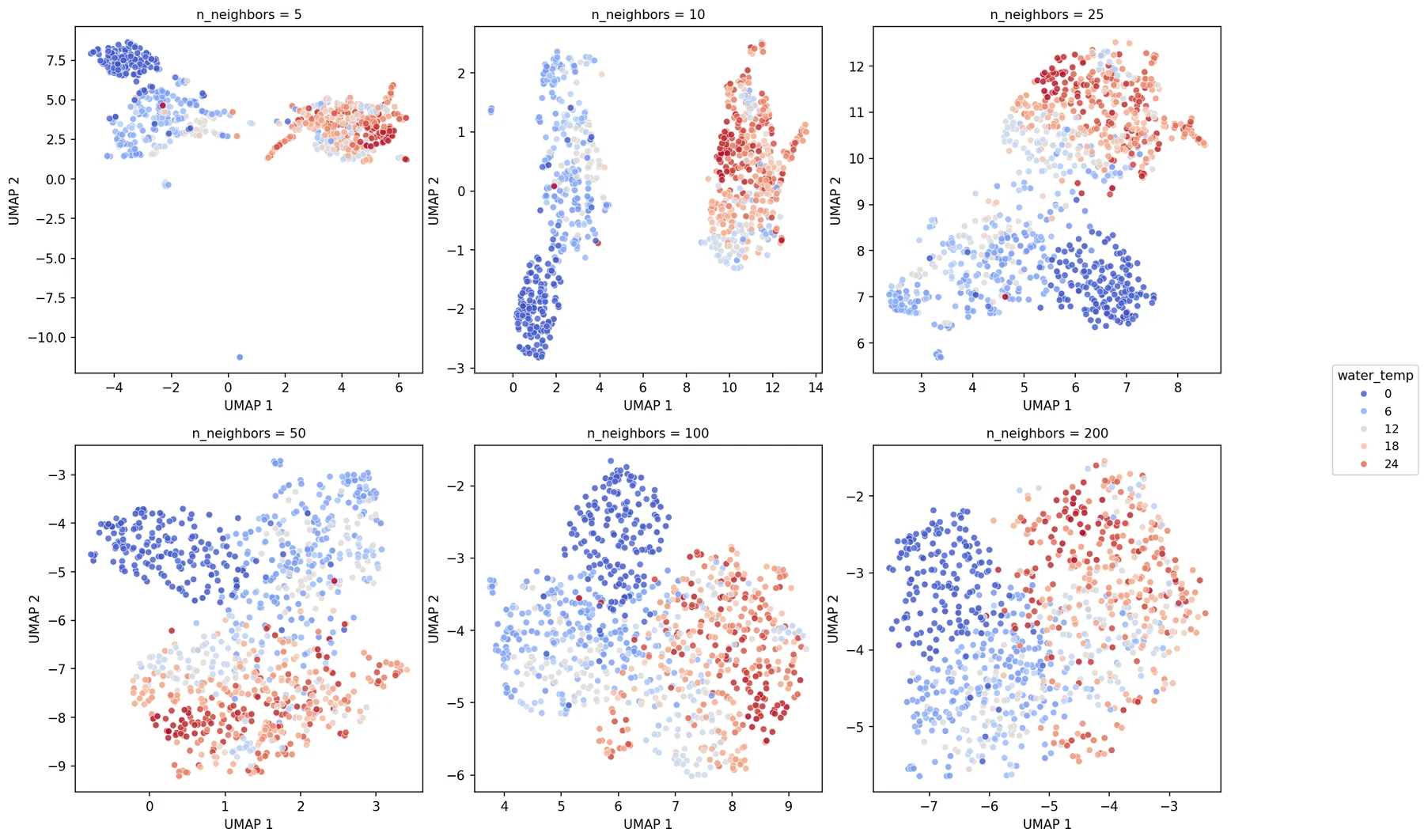
Figure 4. Structure emerges with no feature engineering. UMAP embeddings of the Pyxis identifications, shown across a range of n_neighbors settings, separate samples by water temperature, recovered directly from the raw files with no custom processing.
A gradient-boosted model built on the same annotations then predicted water temperature from lipid profile with an R² of 0.94, quantifying the strength of the relationship rather than only visualizing it.

Figure 5. The relationship is strong and quantitative. A gradient-boosted model trained on the Pyxis biochemome predicts water temperature from lipid profile with R² = 0.94 (mean across 5-fold cross-validation, MAE 1.4 °C). Out-of-fold predictions track the 1:1 line, and the most temperature-predictive features span TAG, SQDG, PC, ceramide, and PS species.
The same law, from a general-purpose model
A trained analyst earns the right to a novel claim by first recovering what is already established. Working from the identical raw files, Pyxis reproduced the study’s headline finding: across the sampled range, the degree of lipid unsaturation in plankton falls as water temperature rises [1]. That reproduction is the control that licenses the extensions shown above.

Figure 6. Pyxis replicates the core finding. Recomputed from the same raw files, weighted mean unsaturation across the published glycerolipid classes (PC, PE, PG, SQDG, TAG) decreases with rising water temperature, reproducing the published relationship without the original custom pipeline.
The headline matches, and what stands out is the breadth beneath it. A bespoke pipeline reports the classes it was built to report. Because the LSM annotates the biochemome as a whole, the same 30-minute run that reproduced the published law also exposed the additional temperature-dependent classes shown at the top of this post, at no extra analytical cost.
A PhD-level co-scientist on the raw data
What this study really shows is a way of working. Pyxis is a co-scientist for omic data, built to interpret molecular measurements and connect them to phenotypic biology. Biochemical omics, reading lipids and metabolites straight from mass spectra, is one of the areas of expertise Pyxis brings to that task; here it let Pyxis arrive at defensible new biology in data that had already been analyzed and published.
For questions where the biology is time-sensitive, the value is as much reach and speed as accuracy. An application scientist who once needed weeks of pipeline engineering to interrogate a lipidomics dataset can now hand Pyxis the raw files and receive an identified, quantified biochemome together with a written, literature-grounded biological interpretation, in the time it takes to read this post. More analytes, added quantitation, and biological reasoning, from a single pass over the data.
For the New Insight Series, we asked Pyxis to search for publications where advanced LC-MS analysis was performed and, in each case, to look for new insights that the original analysis may have overlooked. The global ocean lipidome of Holm et al. is one such study: working from the deposited raw files, Pyxis recovered the published temperature-unsaturation relationship and surfaced additional temperature-dependent lipid classes that the original targeted workflow did not report.
Data: MetaboLights MTBLS2838 (suspended particulate organic matter, HRAM Orbitrap, MS1 + MS2). Original study: Holm et al., Science 376, 1487–1491 (2022). All data figures are from the Pyxis reanalysis of MTBLS2838.
References
Holm, H. C. et al. Global ocean lipidomes show a universal relationship between temperature and lipid unsaturation. Science 376, 1487–1491 (2022). doi:10.1126/science.abn7455
Planktonic ecological networks support quantification of changes in ecosystem health and functioning. Scientific Reports (2023). PMC10550973
Ishikawa, T., Domergue, F., Amato, A. & Corellou, F. Sphingolipids and Δ8-sphingolipid desaturase from the picoalga Ostreococcus tauri and involvement in temperature acclimation. bioRxiv (2023). doi:10.1101/2023.05.16.541044
Keep reading
Working from the raw files behind Holm et al. (Science, 2022), Pyxis reproduced the temperature-unsaturation law and tripled the lipidome.
Discover the meaning in your measurements
Engage with Pyxis on a new experiment or discover the novel biology hidden in data you already have.